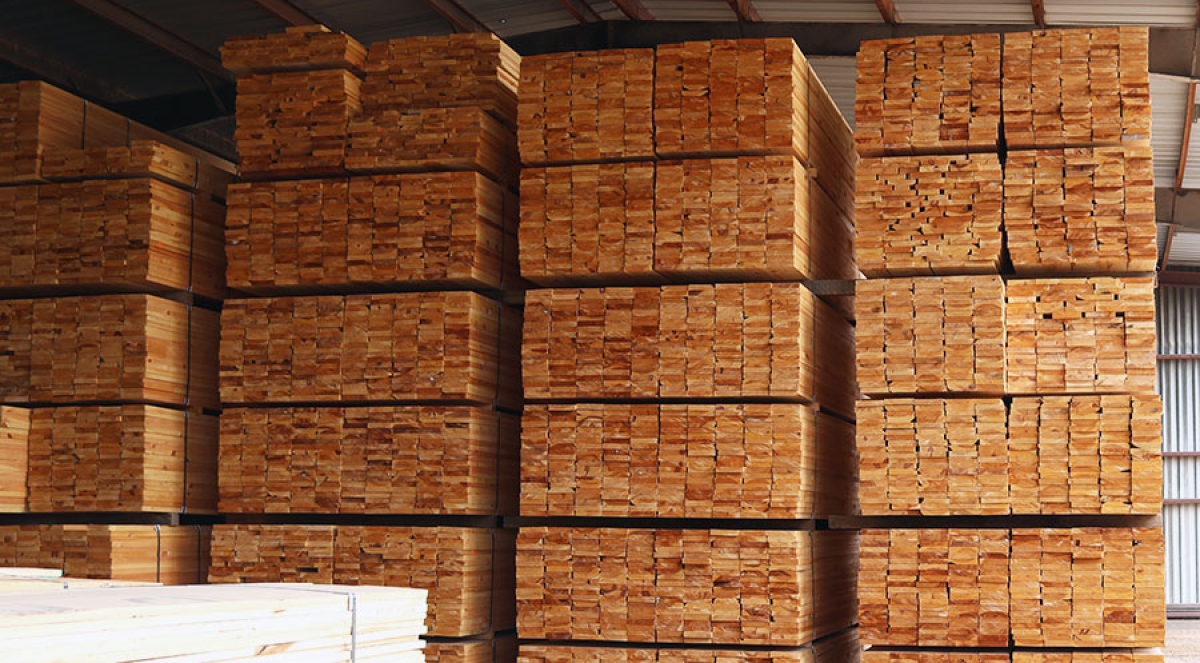
10 Steps From Timber Harvest to Finished Planer Mill Product
Step 1: Harvesting Appalachian Timber
The process begins with responsible timber harvesting. We partner with landowners and logging crews who follow sound forest management practices, selecting only mature hardwoods for harvest. Trees are marked and cut based on spacing, canopy density, and species health. Logging isn’t just about volume: it’s about sustainability, future regrowth, and long-term land value.
Step 2: Breaking Down Logs At The Sawmill
Once at the sawmill, logs are unloaded, scaled, and sorted by species and diameter class. Our team identifies the optimal cutting approach for each log based on end-use targets. For rift-and-quartered white oak, we follow a precise breakdown method to extract straight-grain boards with vertical medullary ray structure. That method involves quartering logs lengthwise, then slicing along radial angles to maintain consistency.
Logs are sawn using a combination of head rigs and resaws to produce rough boards of specific widths and thicknesses. Metal detection ensures safety before boards move to stacking. This stage sets the foundation for what comes next.
Step 3: Preparing Rough-Sawn Lumber For Final Processing
Rough-sawn lumber comes off the saw with variable thickness, uneven faces, and wane along the edges. At the planer mill, boards are selected for final surfacing, grading, and trimming.
Before planing begins, rough lumber is staged by run and tagged with order information to ensure traceability. This step acts as the gateway between sawmill production and specification-grade output.
Step 4: Surfacing And Thicknessing Lumber
The Planer Mill uses industrial planers with carbide knives and heavy-duty pressure bars to control vibration and maintain uniform feed.
Each board is passed through at least one surfacing step. The goal is to remove cup, bow, or saw marks and create an even thickness from end to end. Feed rates, cut depths, and pressure settings are adjusted per species. Rift-and-quartered white oak, for instance, requires tight calibration to preserve its visual texture without burnishing the surface.
We provide:
- S2S (Surfaced Two Sides): Our most common option, ideal for downstream machining.
- S4S (Surfaced Four Sides): Squared and ready for immediate use in millwork, cabinetry, or architectural builds.
- Custom Thicknessing: Set to match exact customer spec, often in stair components or matched sets.
Every pass is quality-checked for chatter, sniping, and over-planing. Bad passes are removed before the next step.
Step 5: Trimming And Edging For Dimensional Accuracy
Once thickness is dialed in, boards must be cut to final width and length. Our edgers remove wane and irregular edges, producing clean, parallel lines. Our optimizing trim saws and then cut to fixed or random lengths depending on the job.
We routinely cut:
- Standard lengths for domestic inventory
- Specified lengths for customers building face frames, treads, or panels
- End-trimmed bundles for export packing requirements
Accurate trimming reduces defects, improves yield per board, and eliminates the need for secondary processing at the customer site. For many, this is the difference between profit and waste.
Step 6: Grading And Sorting Finished Boards
With surfaced faces and clean edges, boards can now be accurately graded. Our NHLA-certified graders evaluate each piece based on clear cutting units, defect locations, and face characteristics. Grading isn’t cosmetic: it’s about usable yield per board.
We apply standard grade categories:
- FAS (Firsts and Seconds): Maximum clear area for furniture or cabinetry.
- Select: A mix of clear and character areas, suitable for visible structural work.
- #1 Common: Often used in flooring, millwork cores, and utility applications.
Boards are then sorted by:
- Species
- Grade
- Thickness and width class
- Destination (domestic or export)
For international shipments, we double-check bundle tags, apply language-specific labels, and include required documentation with each load.
Step 7: Fulfilling Custom Requirements At The Planer Mill
No two customers build the same way. That’s why we offer additional value-added processing for clients who need boards tailored to their workflow.
Our mill produces:
- Straight-line ripped blanks: With one true edge, ready for ripping or gluing
- Moulder-ready sets: Uniform dimensions for immediate production use
- Color-sorted runs: Cherry or walnut pulled for matching visible faces
- Fixed-width pulls: For components like drawer sides, stair risers, or cabinet rails
We also support pack splitting, small-batch trials, and multi-spec shipments. Every customization is logged and labeled at the pack level.
Step 8: Processing Appalachian Hardwood Species
We process a wide range of Appalachian hardwoods and tailor our methods to each one. Species vary in grain, density, machining characteristics, and drying behavior. Our team makes real-time adjustments to deliver clean surfaces and tight tolerances across the board.
- Rift-and-quartered white oak: Precision sawn, slowly dried, and lightly surfaced to preserve texture
- Walnut: Milled with sharp knives to preserve color and avoid fiber fuzzing
- Cherry: Surfaced with caution to avoid gum pocket breakout
- Maple: Run at high feed rates but checked for chip-out and burn
- Poplar: A production workhorse for S4S and moulding stock
No matter the species, we treat each one with its own set of best practices.
Step 9: Packaging And Delivering Finished Boards
Finished lumber is packed with care. Boards are tallied, bundled, and labeled with species, thickness, grade, and run number. Every shipment receives a packing list and barcode to ensure traceability.
We offer:
- Domestic bundles: Paper-wrapped or banded for mill direct or distributor delivery
- Export packaging: Heat-treated dunnage, strapped units, and plastic wrap per ISPM-15
- Custom tags: For brokers, private labels, or in-transit identification
Whether shipping to a cabinet shop in Kentucky or a container port in Norfolk, we make sure boards arrive in spec and ready to use.
Step 10: Completing The Process At The Planer Mill
The Planer Mill often serves as the final touchpoint before lumber leaves our facility, refining rough boards into precision-surfaced material. The Planer Mill turns rough boards into precision-surfaced material, ready for use in manufacturing or woodworking. Surfacing, trimming, and grading transform rough boards into ready-to-use products that meet the demands of modern manufacturing.
We close the loop by delivering results that matter to our customers:
- Boards that meet real-world tolerances
- Products that save our customers time and money
- Shipments that meet domestic and export spec
The Planer Mill is the final, indispensable step that ensures precision, improves uniformity, and delivers tailored output that fits a wide range of final applications.
Choose Church And Church Planer Mill For Finished Hardwood Products
We refine each board so it meets the expectations of those who use it: cleanly surfaced, accurately cut, and fully prepared for its next purpose.
If your business depends on hardwood lumber that’s surfaced, trimmed, graded, and ready for use, our Planer Mill delivers the final step with accuracy and consistency. Whether you’re building cabinetry in Tennessee or exporting red oak to Asia, we make sure the product meets spec.
Contact us for more information about our Planer Mill.